
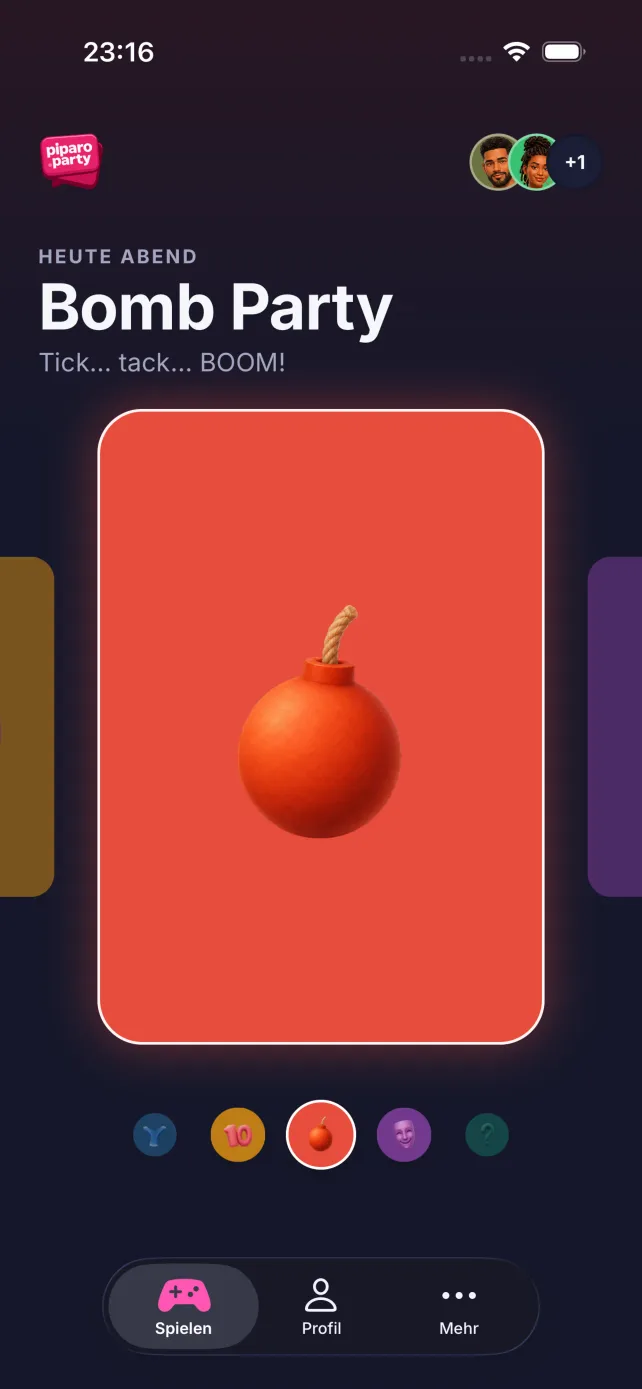
piparo.party is an offline-first party-game app built by our small team at piparo.tech. It brings 25 games into one polished experience that starts without an account, works without a connection, and supports 22 languages.
Project Overview
We built the product end to end: product strategy, brand, mobile architecture, game content, monetisation, website, store delivery, and production operations. The central product constraint shaped the entire system: a group should move from opening the app to playing in under a minute.
The app combines a restrained dark shell with a separate colour world for every game. Underneath that interface is a modular game platform that supports quick card games, timed rounds, team play, social deduction, persistent player profiles, and an upcoming local Bluetooth multiplayer mode.
Key Contributions
Product and Mobile Architecture
Designed the application around Expo Router, strict TypeScript, and feature-oriented modules. Shared navigation, session, theme, storage, and platform services keep the growing game catalogue consistent without forcing every game into the same interaction model.
Modular Game Platform
Built a plugin-based catalogue for 25 games across card, word, timing, voting, bluffing, and role-based formats. Each plugin owns its metadata and play flow while reusing common setup, crew, result, and access-control foundations.
Offline Content System
Implemented local SQLite content databases so games remain fully playable without a network connection. Release assets are validated and encrypted with SQLCipher, while locale-specific databases keep the installed content manageable.
Design System and Game Themes
Created shared design tokens, runtime themes, and reusable native primitives for buttons, tiles, sheets, navigation, and screen frames. The shell stays calm and recognisable while every game can fill the screen with its own colour, motion, and visual identity.
Local Multiplayer Foundation
Developed a Bluetooth Low Energy session layer for nearby devices, including hosting, joining, roster state, round synchronisation, and resilient reconnects. The architecture lets supported games add multiplayer without duplicating transport and lifecycle logic.
Internationalisation at Product Scale
Structured app and website copy around Lingui and locale-specific content assets. The product ships in 22 languages, including translated game content, settings, onboarding, purchase flows, metadata, and the marketing website.
Subscriptions and Cross-Platform Payments
Implemented the Free and Pro model with native App Store and Google Play purchases through expo-iap. The web experience adds Stripe checkout, while entitlement handling, restore flows, cancellation messaging, and local persistence remain explicit and testable.
Profiles, Trophies, and Platform Services
Built persistent player profiles and a quiet achievement system that works locally first. Selected milestones are mirrored to Apple Game Center and Google Play Games Services without making platform accounts a requirement for normal play.
Website and Store Delivery
Built the multilingual Astro website, store metadata workflows, screenshot generation, and release automation around EAS. Shared assets and product copy stay aligned across the app, website, App Store, and Google Play.
Quality and Observability
Established type checks, Jest coverage, deterministic fixtures, and native and web end-to-end suites across the game catalogue. Sentry, scoped logging, source maps, dSYMs, and Android mapping uploads make production failures diagnosable.
Technology Stack
Mobile
- React Native 0.85
- Expo 56
- Expo Router 6
- TypeScript
- Reanimated 4
Data & State
- Zustand
- MMKV
- SQLite / SQLCipher
- XState
- Lingui
Platform
- expo-iap
- Bluetooth LE
- Game Center
- Google Play Games
- Sentry
Delivery
- Astro
- EAS
- pnpm
- Nix
- Jest & E2E
End-to-End Product Ownership
Beyond implementation, the work includes product positioning, pricing, store compliance, release planning, content operations, analytics decisions, and the visual system. That breadth makes piparo.party a useful reference for how I approach a product when mobile, web, design, infrastructure, and operations need to move as one system.